Understanding Forestry Mulching and Its Role in Modern Land Management
In recent years, forestry mulching has become an increasingly important method in modern land management, offering a practical way to clear and maintain vegetation while supporting environmental sustainability. This approach uses specialized equipment to grind trees, brush, and undergrowth into mulch that is redistributed across the land, helping to stabilize soil and improve long-term ground conditions. As land development, wildfire prevention, and habitat management continue to grow in priority, forestry mulching provides a balanced solution that supports both usability and ecological health.
The appeal of forestry mulching also comes from its efficiency and adaptability across different terrains and project sizes. According to Farmonaut.com, mulching crews may clear 1 to 3 acres per day, depending on vegetation type, terrain, and weather. This level of productivity makes it a strong alternative to more traditional clearing methods that often require multiple stages of equipment and labor.
Understanding Forestry Mulching
This technique is a land clearing process that uses a single machine to cut, grind, and clear vegetation in one continuous operation. Instead of removing trees and hauling debris off-site, the material is processed directly into mulch and left in place. This helps reduce soil disruption while improving moisture retention and limiting erosion over time. The result is a cleared area that remains protected by a natural layer of organic material.
Over time, forestry mulching has developed alongside improvements in machinery and land management practices. Earlier clearing methods often relied on bulldozers, burning, or multi-step removal processes that left soil exposed and increased the risk of erosion. Modern mulching techniques reduce these impacts by keeping organic material on-site and simplifying the entire clearing process into a single pass.
Equipment used in forestry mulching ranges from compact machines for residential lots to large industrial units capable of clearing dense forests. These machines use reinforced cutting heads designed to break down trees, saplings, and brush into fine mulch efficiently. The ability to complete multiple steps at once is what makes forestry mulching both time-saving and practical for a wide range of land conditions.
Efficiency and Speed in Forestry Mulching
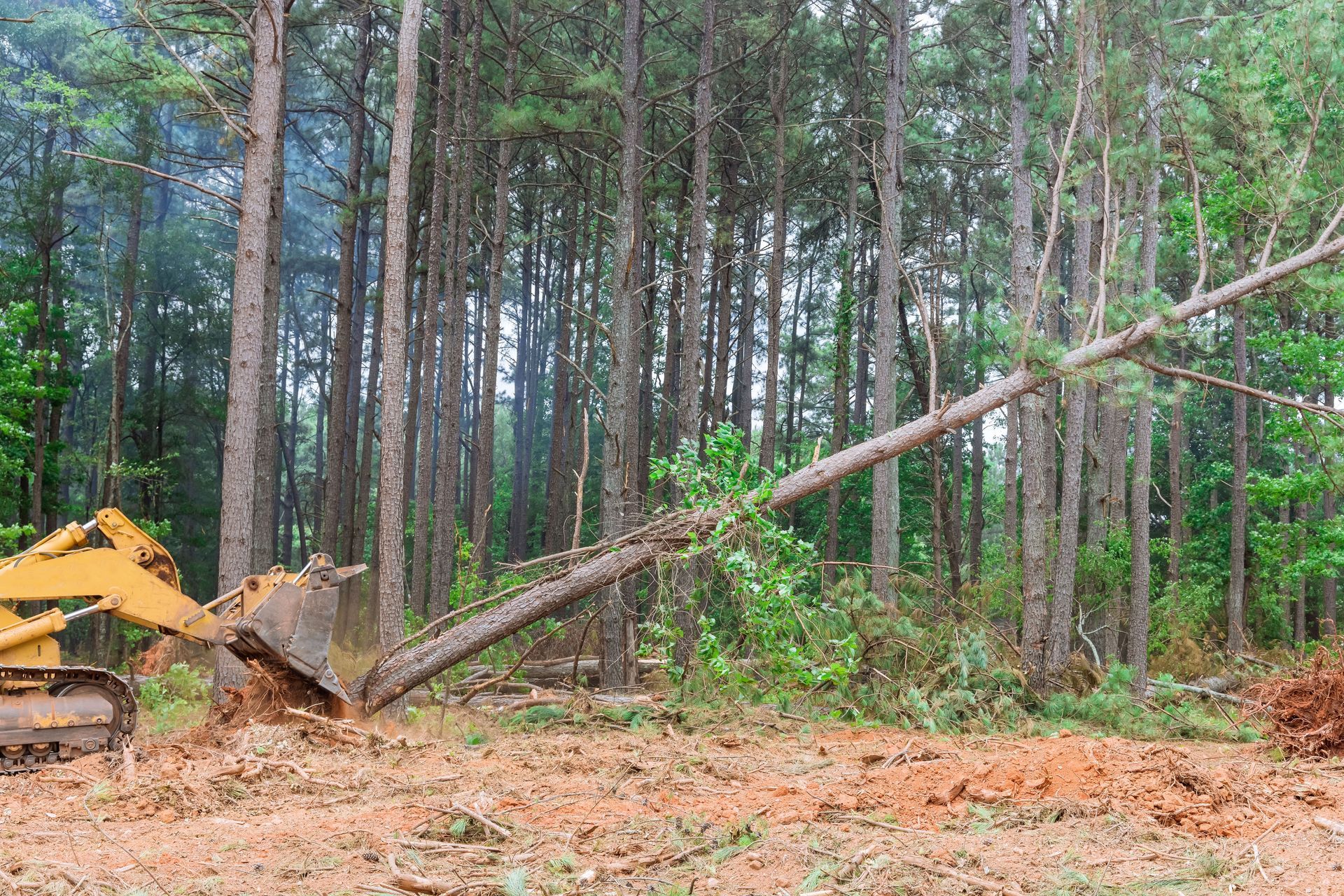
One of the biggest advantages of forestry mulching is its speed compared to traditional land clearing methods. Because cutting and grinding happen simultaneously, there is no need for hauling debris or performing secondary cleanup, which significantly reduces project timelines.
Light brush on flat ground can be cleared quickly, while dense forest or uneven terrain may reduce daily output. Even with these variations, forestry mulching remains one of the fastest methods for clearing overgrown land.
Equipment capability and operator experience also play a major role in productivity. Modern machines are designed for continuous operation and improved cutting efficiency, while skilled operators can adjust techniques in real time based on site conditions. This combination helps maintain steady progress and reduces unnecessary delays.
Environmental and Practical Benefits
Forestry mulching provides several environmental advantages over traditional clearing methods. Since vegetation is converted into mulch and left on-site, it helps protect soil from erosion and improves moisture retention. Over time, this organic layer breaks down and returns nutrients to the soil, supporting healthier ground conditions.
Another benefit is reduced waste. Because there is no need to haul away debris, fuel use and emissions associated with transportation are minimized. This makes forestry mulching a more environmentally responsible option for land clearing projects.
The process is also highly versatile. It is used in agricultural preparation, wildfire prevention, utility corridor maintenance, residential clearing, and ecological restoration. Its ability to adapt to different environments makes it a valuable tool for both small and large-scale land management needs.
Factors That Influence Project Performance
Several factors determine how quickly forestry mulching can be completed. Vegetation type and density are major influences, with thicker forests requiring more time than light brush or open fields. Terrain also affects productivity, as steep or rocky ground can slow machine movement and require more careful operation.
Weather conditions play an important role as well. Dry, stable weather supports optimal performance, while wet or muddy conditions can reduce traction and slow progress. Proper planning around seasonal conditions helps improve efficiency and reduce delays.
Operator skill is another key factor. Experienced operators can make real-time adjustments that improve machine performance and reduce wasted movement. Pre-project planning and site evaluation also help ensure that equipment and crews are used as efficiently as possible.
Long-Term Value of Forestry Mulching
Beyond immediate clearing results, forestry mulching provides long-term land management benefits. The mulch left behind helps suppress weed growth, improve soil structure, and reduce erosion. These effects can significantly reduce the need for ongoing maintenance.
Because the process is less disruptive than traditional clearing, it also helps preserve surrounding ecosystems. Wildlife habitats are less disturbed, and native vegetation has a better chance of regenerating naturally. This makes forestry mulching especially useful in environmentally sensitive areas.
Future Innovations in Forestry Mulching
Forestry mulching continues to evolve as new technologies and shifting land management demands reshape how clearing projects are planned and executed. One of the most noticeable advancements is the improvement in machine design and overall efficiency. Modern machines are being built with stronger cutting systems, improved hydraulic power, and better heat management, allowing them to operate for longer periods without performance loss. These upgrades make it possible to handle thicker vegetation, larger trees, and more challenging terrain while maintaining consistent output across the entire project.
Another major area of development is the integration of digital systems into forestry mulching equipment. GPS tracking, mapping software, and onboard diagnostics are becoming more common, giving operators real-time insight into where they've worked, how much land has been cleared, and where adjustments may be needed. This level of precision helps reduce overlap, prevents missed sections, and allows crews to plan more efficient routes across a property. Over time, these tools also help improve reporting accuracy, which is especially useful for larger commercial or municipal projects that require documentation of progress.
Automation is also starting to play a larger role in forestry mulching operations. While fully autonomous machines are still emerging, semi-automated systems are already improving consistency in cutting depth, movement patterns, and material processing.
Environmental monitoring technology is another innovation shaping the future of forestry mulching. Sensors that track soil conditions, moisture levels, and vegetation density are helping operators make more informed decisions before and during clearing work. This real-time data allows crews to adjust their approach based on actual site conditions rather than estimates alone. As a result, projects can be completed more efficiently while minimizing unnecessary disturbance to the surrounding environment.
Forestry mulching has established itself as one of the most efficient and environmentally conscious land clearing methods available today. By combining cutting and grinding into a single process, it reduces project timelines while maintaining soil health and minimizing disruption to surrounding ecosystems. With crews capable of clearing 1 to 3 acres per day, depending on conditions, it offers a practical balance of speed and sustainability.
As technology and land management practices continue to advance, forestry mulching will remain an important solution for clearing and maintaining land efficiently. For property owners and project managers, it provides a reliable way to transform overgrown areas into usable space while supporting long-term environmental health. Contact a
forestry mulching professional at Premium Ground Worx to assess your property and determine the best approach for your project.